ASYNCHRONOUS LEARNING PLATFORM

Immersive asynchronous learning built for engagement, not passive replay.

Engageli transforms recorded sessions into immersive asynchronous learning experiences with playback rooms.  By preserving the live classroom's game-based quizzes, knowledge checks, and learning activities within the recorded session, Engageli delivers an asynchronous learning experience that goes far beyond passive video replay. 

Asynchronous_hero
THE CATEGORY

What is an asynchronous learning platform?

An asynchronous learning platform delivers structured learning experiences that learners complete at their own pace, on their own schedule. Rather than simply replaying a recorded class, learners participate in quizzes, activities, embedded resources, and AI-powered learning supports while instructors gain insights into engagement, progress, and learning outcomes. 


Engageli playback room

Engageli Playback room (1)


Video conferencing tools


video_conferencing-1


HOW IT WORKS

Reimagining asynchronous learning

Core pillars of Engageli’s asynchronous learning experience and how it goes beyond traditional video recordings.
Interactive playback
Every recorded class becomes an active learning environment where learners participate in quizzes, polls, knowledge checks, and activities, not just watch a video.
One classroom, any schedule
The same interactive classroom serves both live and asynchronous learners, delivering consistent instruction, engagement, and measurable learning outcomes.
AI-enriched learning
Engageli AI transforms recordings into engaging lessons with automatically generated quizzes, podcasts, reflection prompts, and other resources.
Learning in context
Sprints, activities, and supporting content appear at the intructional moments in the recording, reinforcing concepts exactly when learners encounter them.
Self-paced learning
Learners pause, replay, take digital notes, complete activities, and revisit key concepts without losing the structure of the classroom experience.
Unified learning insights
Live and asynchronous participation, engagement, and assessment results are combined into a single learner record, giving instructors a complete view of progress.
THE CHALLENGE OF VIDEO RECORDINGS

Most asynchronous learning is just video watching. Engageli is interactive.

Most asynchronous learning experiences consist of watching a video and posting a comment. The experience is passive, with few opportunities to interact, demonstrate understanding, or receive meaningful feedback. For instructors, completion metrics and click counts provide little insight into whether learning actually occurred.


Engageli's asynchronous learning takes a fundamentally different approach. Rather than replaying a recording, it transforms every recorded class into an interactive learning experience. Polls, quizzes, activities, digital notes, and other engagement tools remain fully interactive, allowing asynchronous learners to participate just as live attendees did. Their responses are captured alongside live participation, creating a single, continuous engagement record for every learner.


The result is an asynchronous learning experience that delivers the same active learning, participation, and measurable outcomes as the live classroom on the learner's own schedule. 


THE ASYNCHRONOUS FEATURES

Immersive learning features of the playback room

Recording_ Screen share (1)

Engaging self-paced learning


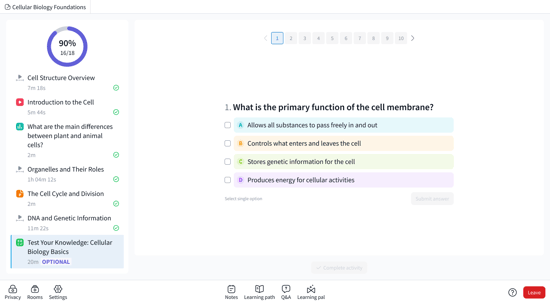
Extend asynchronous learning with an added AI dimension in Engageli's playback room. Transform class recordings and video content into interactive learning experiences with embedded polls and quizzes, AI-generated podcasts, and AI-powered tutoring, so neurodiverse learners can review, practice, and deepen understanding on their own time. Supplement with additional materials in the playback room for knowledge building and application.

Communication tools


Create equitable learning experiences with persistent discussion boards and chat replays in playback rooms, allowing asynchronous learners to stay connected to both the live session and dynamic side conversations.


Recording_ Screen share (2)


Module_ Quiz – 1


Checks for understanding


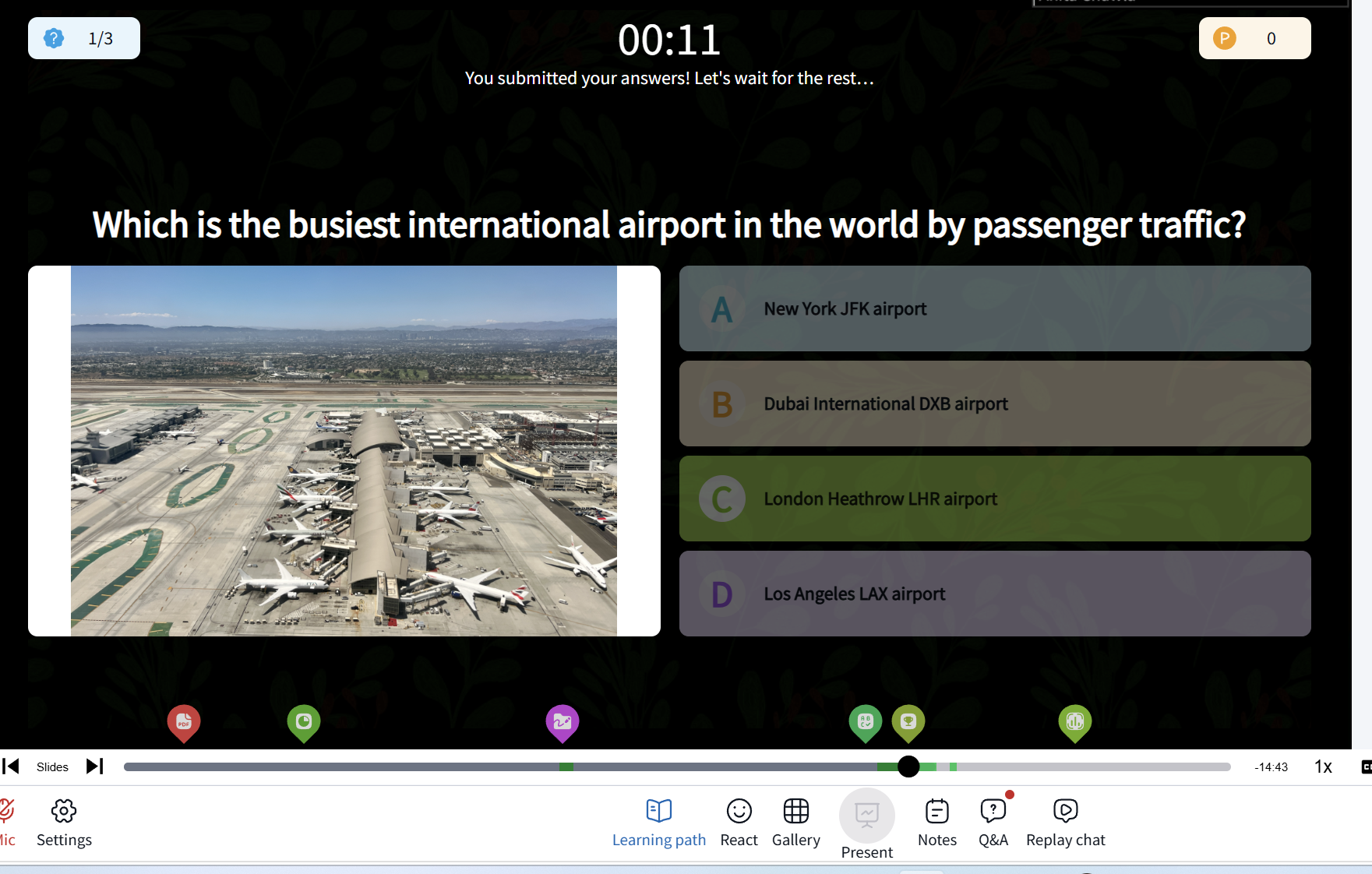
Leverage polls and quizzes, created by AI from defined source materials, to guide practice, prompt learners to reflect on what they’ve learned, and gauge comprehension. View how others have answered after submitting a response, enabling comparison, deeper reflection, and peer-informed learning. Learning can be further gamified by allowing asynchronous learners to rank on leaderboards.


Class summaries and notes


Enhance retention using AI generated class summaries to highlight key concepts. Automatically condense complex content into sub-topics for easier reviews that are available alongside the recorded classroom. ​

Access your class notes in the playback room to maintain a continuous, always-available notebook within the multimodal classroom.


File Share + Side Gallery (3)


Welcome – 1

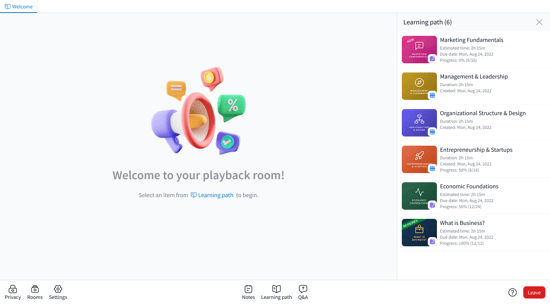
Recordings playlist


Rename recordings with clear, descriptive titles that reflect the content, making it easy to organize them into an identifiable playlist. Enhance the asynchronous classroom by adding complementary materials aligned to a logical scope and sequence, creating a rich, accessible experience  for anytime learning.


Sequenced materials in a playlist allows students to revisit material based on topic progression.

Connected asynchronous learning


Shift from passive, LMS-hosted asynchronous content to interactive playback experiences, enabling deeper engagement and actionable insights into student learning through analytics.

Engagement analytics can help close this gap by informing student support services when learners are disengaged or struggling with specific concepts, enabling timely and individualized interventions.
 

Light Mode UI - Large Size (17)

THE ENGAGELI DIFFERENCE

Up to 50 learners in the same collaborative space.

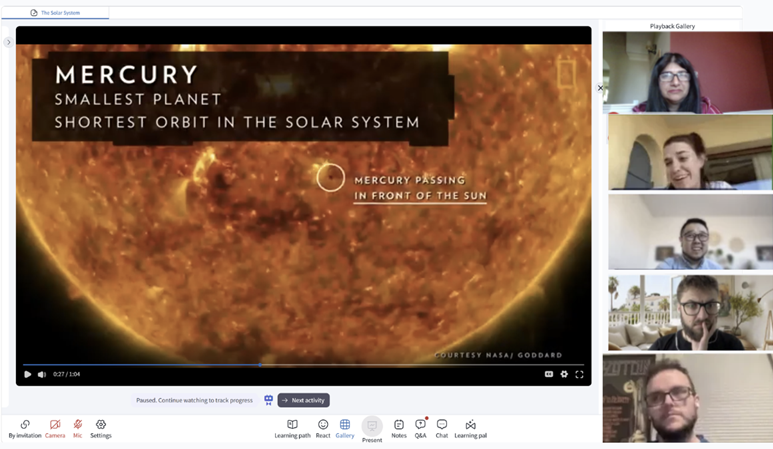
Up to 50 learners can join the same playback room simultaneously, engaging in the recorded classroom together, participating in polls, asking questions, and building community as they learn. That fundamentally changes the power of asynchronous learning.
galleryof50-1
K-12
A group of high school students host virtual study sessions in the playback room, while accessing the class instruction, discussion boards and reviewing concepts.
Higher Ed
Learners can collaborate on a group project and work together in the playback room, can accessing class materials for shared context from the original class.
Corporate L&D
A team of new hires across time zones can onboard together in the playback room, learning from the same content while building global connections in real time. 


asynchronous_poll_responses


ANALYTICS

Measuring asynchronous learning


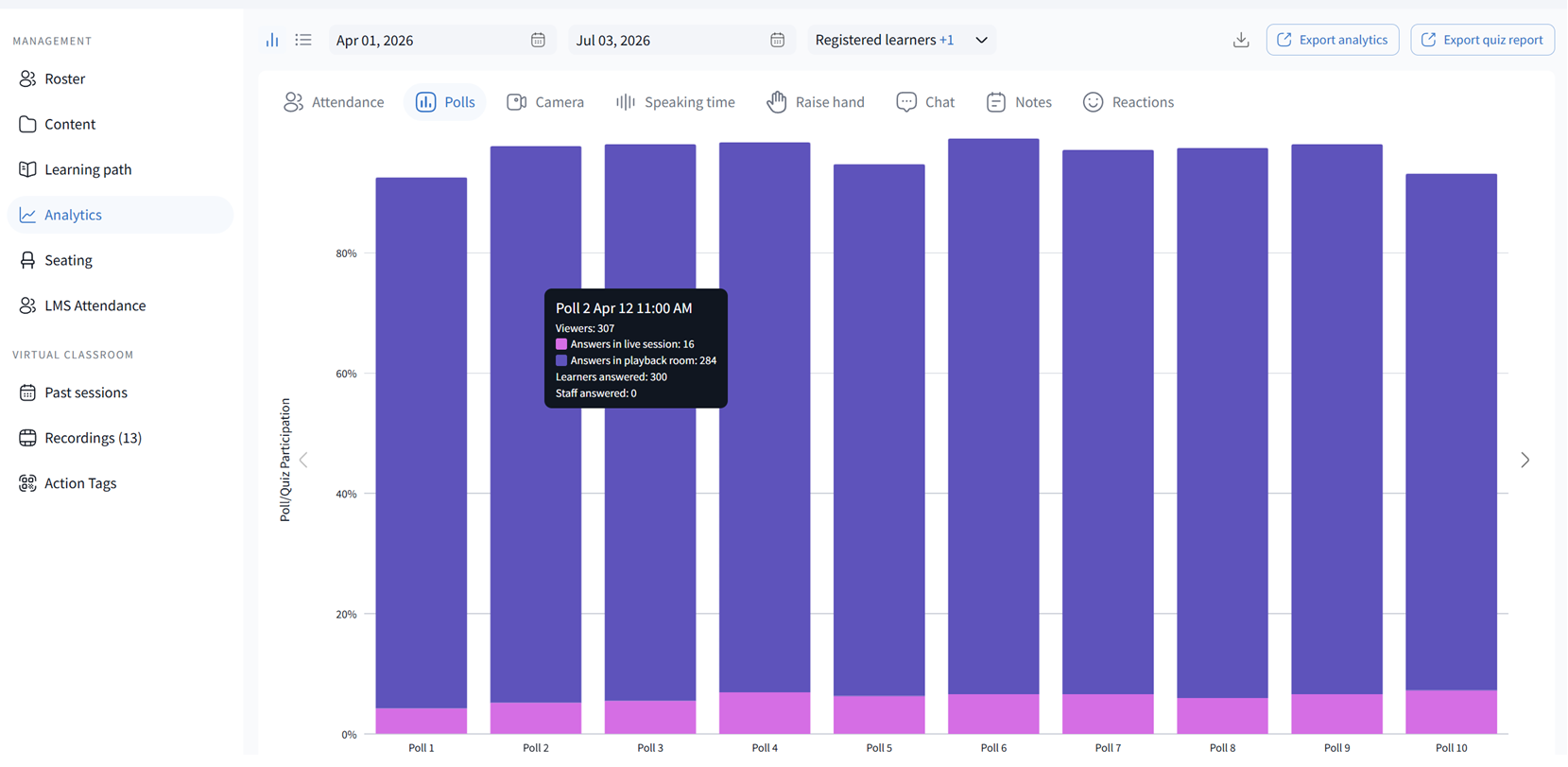
Engageli tracks attendance in recorded classrooms and measures engagement in polls, quizzes, and sprints through dashboards and reports, giving instructors a complete view of learner understanding, regardless of how or when learning takes place. 


Asynchronous learning analytics matter because instructors don’t have the natural visibility they get in a live classroom. Without analytics, “completion” often becomes the only signal of learning, which doesn’t indicate whether learners actually understood or engaged with the material.

 

SUPPORTING STATISTICS

Institutions have access to actionable asynchronous learning insights.

92%

playback room attendance compared to 8% live class attendance for institutions supporting working adult learners.

43%

change in live class delivery to support active learning experiences in the playback room.

600K+

learners served weekly in active, online classrooms worldwide, with asynchronous learning support

Ready to see Engageli in action?

Speak to our team of educators to see how Engageli's virtual classroom supports engaging multimodal learning while giving instructors visibility into engagement.

Got questions? We’ve got answers

Asynchronous learning is any learning that happens outside a scheduled live session, on the learner's own time, at their own pace. It includes recorded lectures, self-paced modules, and on-demand course content.

Most async learning is passive. A learner watches a recording, absorbs what they can, and moves on. Engageli's asynchronous tools work differently. Playback Rooms let learners review content individually or in groups of up to 50, answer embedded polls, ask questions in a persistent Q&A, and take notes that carry forward into every session. The learning stays active even when the instructor isn't in the room.
Asynchronous e-learning is digital-first self-paced learning, courses and modules learners access on demand rather than at a scheduled time. No meeting link. No synchronized schedule.

The problem with most async e-learning is that it's static: a video plays, a quiz appears, the learner clicks through. There's no collaboration, no accountability, and no way for the instructor to know whether the content landed.

Engageli Studio changes that model. Instructors upload existing videos or presentations and the platform automatically segments them into micro-lessons, generates polls and quizzes based on the content, and adds an AI tutor that answers learner questions in real time. The result is async e-learning that behaves more like a live class than a recording.
Synchronous learning happens in real time, a live class, webinar, or virtual session where instructor and learners are present together. Asynchronous learning happens on demand, recorded sessions, self-paced modules, and on-demand content learners access on their own schedule.

Most platforms make you choose one. Engageli is built for both, and keeps quality consistent across both. A live Engageli classroom automatically becomes an interactive Playback Room after the session ends, with the same polls, notes, and Q&A available async that were available live.

At DeVry University, up to 75% of students choose to attend their Engageli classes asynchronously in any given week. Those students are not getting a different product, they are getting the same product, on their schedule.
Synchronous advantages: real-time feedback and questions, live cohort connection, high-stakes practice with immediate coaching. Disadvantages: scheduling friction across time zones, attendance barriers for working learners, fixed pace for all.

Asynchronous, advantages: learner schedule flexibility, consistent content quality across cohorts, self-paced mastery, scale without increasing instructor load. Disadvantages: engagement decay without active-learning design, accountability harder to enforce, learner isolation if left unsupported.

The honest answer is that most effective programs use both. Engageli's multimodal design supports synchronous sessions that automatically become interactive async resources, with engagement data flowing into a single dashboard across both modes.
Five benefits that show up in the data:

1. Flexibility at scale. Reaching 1,000 learners with active training takes 7–9 virtual sessions in Engageli, compared to 25–40 in-person. Async extends that reach further.

2. Consistent quality. A well-designed async module delivers the same experience to the 1,000th learner as it did to the first. Live delivery varies by facilitator energy and class composition.

3. Self-paced mastery. Learners can pause, rewatch, and review sections they didn't retain the first time.

4. Global accessibility. Distributed teams across time zones can complete the same training without scheduling a session that works for nobody.

5. Accountability data. Engageli tracks async attendance the same way it tracks live attendance, total minutes viewed, poll responses, Q&A participation. Instructors see who showed up async and who didn't.
Three real problems with async learning, and what Engageli does about each:

1. Low engagement. Most async content is passive, watch, click next, forget. Engageli's Playback Rooms embed polls, quizzes, and Q&A directly in the recorded session. Learners answer the same activities the live class answered. Completion isn't watching the video, it's participating in it.

2. No accountability. Without a live instructor, learners skip content or skim. Engageli tracks minutes viewed, poll responses, and Q&A participation per learner, per session, asynchronously. Instructors see exactly who engaged and who didn't.

3. Learner isolation. Self-paced learning can feel disconnected. Engageli's group Playback Rooms let up to 50 learners watch and discuss together, chat, audio, and collaboration tools available, even without a scheduled session. It works more like a study group than a recording
Yes, when it's designed to be active. Passive async learning (watch a video, take a quiz, forget most of it by Friday) consistently underperforms live instruction. That's not a feature of asynchronous learning. That's a feature of passive delivery.

Engageli's research shows that active learning, in any modality, produces 54% higher test scores than passive delivery of the same content. The key variable isn't whether the session is live or recorded. It's whether the learner is doing something during it.

Engageli's Playback Rooms are built on that premise: embedded activities, group viewing, and persistent engagement tracking that holds learners accountable even without a live instructor in the room.
Three examples from real Engageli deployments:

1. DeVry University. Adult learners attend classes live or review them asynchronously in Playback Rooms on their own schedule. Up to 75% of students choose async in any given week, with 44% of that viewing happening on weekends, fitting learning around full-time work.

2. Global sales onboarding. A B2B company uses Engageli Studio to build async onboarding modules from existing training videos. New hires across time zones complete the same structured program, with embedded quizzes and an AI tutor available 24/7, without a live facilitated session.

3. Flipped classroom. A university instructor uploads pre-class reading materials and short concept videos as Engageli Studio modules. Students complete them before the live session. Live class time is used entirely for application and discussion, not content delivery.
Four activity types that outperform plain video in async environments:

1. Interactive Playback Rooms. The live session recording plus embedded polls, Q&A, and notes. Learners answer the same activities the live class did, and their responses flow into the same engagement dashboard.

2. Group async viewing. Up to 50 learners in the same Playback Room, watching together, chatting, and discussing as they go. The social dimension pulls engagement numbers up significantly versus solo viewing.

3. Self-paced Studio modules. Purpose-built async content with AI-generated quizzes, micro-lesson segmentation, and an always-available AI tutor (Learning Pal) for learners who get stuck.

4. Social annotation. Shared collaborative documents where learners annotate readings or case studies over time. Engagement compounds across the cohort, each learner sees the previous readers' insights.
Five practices that separate async programs that work from ones that don't:

1. Design for active, not passive, engagement. Every async session should require something from the learner every 3–5 minutes, a poll, a question, a decision point, a note.

2. Track async attendance like you track live attendance. Accountability works async too. Learners who know their participation is visible engage measurably more than those who don't.

3. Use cohort-based deadlines, not fully self-paced. Learners who know peers are progressing alongside them complete at significantly higher rates than learners on infinite timelines.

4. Keep the async experience structurally identical to the live experience. In Engageli, a Playback Room and a live class have the same tools, the same polls, the same interface. The learner doesn't switch contexts to switch modes.

5. Review the engagement data after every session. Async attendance patterns reveal where content is losing learners, and where to intervene.
Five criteria that separate async-capable platforms from async-first ones:

1. Interactive, not just video. Does the platform let learners do anything during async review, or just watch a recording? Passive video is the default. Active interaction is the differentiator.

2. Engagement analytics per learner, per session. Can you tell who watched, for how long, and what they engaged with? Or just whether the link was clicked?

3. Group async capability. Solo viewing is a recording. Group async viewing, learners watching and discussing together, on their own schedule, is a learning experience.

4. Integration with live sessions. The async experience should share a link, a dashboard, and an interface with the live classroom. Switching platforms to switch modes kills continuity.

5. LMS compatibility. Deep integration with Canvas, Blackboard, D2L, and similar systems means async content lives where learners already look, not in a separate tool.
Here's the workflow:

1. An instructor runs a live Engageli session, tables, polls, Q&A, shared documents, all of it.

2. The session ends. Within minutes, an AI-generated summary is emailed to the instructor and placed in the Playback Room.

3. The Playback Room opens automatically under the same classroom link, no separate recording to manage.

4. Learners join the Playback Room solo or in groups of up to 50. They watch the session, answer the original polls, ask questions in Q&A, and take notes that persist into their next session.

5. The instructor sees async attendance data alongside live attendance, who watched, for how long, and what they engaged with.

For courses built in Engageli Studio rather than recorded from live sessions, the workflow starts with uploaded video or presentation content. The platform auto-segments the content into micro-lessons, generates polls and quizzes, and adds the AI tutor.
A practical framework:

Use synchronous for: new concept introduction that benefits from real-time Q&A, cohort-building and relationship development, high-stakes skill practice with immediate coaching, sessions where learner questions should shape the content.

Use asynchronous for: content review and reinforcement after a live session, compliance and procedural training that needs to reach distributed teams on their schedule, self-paced skill building where learner pace varies widely, content that benefits from repetition or rewatch.

The honest answer is that the best programs use both. Engageli is built for that: live sessions automatically become interactive async resources, and engagement data from both modalities flows into the same dashboard.
Three reasons that show up in the numbers:

Scale. Reaching 1,000 learners in-person requires 25–40 separate sessions. Virtually, that drops to 7–9. Asynchronous delivery extends that reach further, learners who can't attend live don't fall through the cracks.

Access equity. A learner with a difficult schedule, a slow connection, or a family obligation can still complete the same program as their peers. Async removes barriers that live sessions create for non-traditional learners.

Cost efficiency. The cost per learner for active virtual training is roughly one-tenth the cost of in-person active delivery, and async extends that efficiency further by eliminating synchronized scheduling entirely.
Three changes that move the needle:

1. Replace passive recordings with interactive Playback Rooms. A recording that plays and stops is a video. A Playback Room where learners answer polls, participate in Q&A, and take persistent notes is a learning experience. The format determines the engagement, not the content quality.

2. Track async attendance the same way you track live attendance. If learners know their async participation is visible, minutes viewed, polls answered, questions asked, completion rates improve. Accountability works asynchronously too.

3. Build in moments that require something from the learner every few minutes. Engageli Studio automatically segments long videos and generates embedded polls and quizzes based on the content. Learners who are prompted to do something every 3–5 minutes retain significantly more than learners who watch straight through.
Self-paced learning is a subset of asynchronous learning. All self-paced learning is async, but not all async learning is self-paced.

The distinction is cohort structure. Asynchronous learning just means 'not at the same time.' Self-paced learning adds: 'and without a shared deadline.' A learner progressing through a 6-week Engageli Studio module on their own schedule is in a self-paced experience. A cohort of learners working through the same module with weekly milestones is asynchronous but not fully self-paced.

Engageli supports both. Engageli Studio is purpose-built for self-paced modules, upload content, auto-generate quizzes, add the AI tutor, and learners progress at their own pace. Playback Rooms work for both cohort-paced async (learners review last week's session before this week's) and fully self-paced review (learners return to old sessions whenever they need them).

The benefits overlap (flexibility, scale, accessibility). Self-paced adds: deeper mastery for learners who need more time, and lower instructional overhead for programs that don't need synchronized progression.